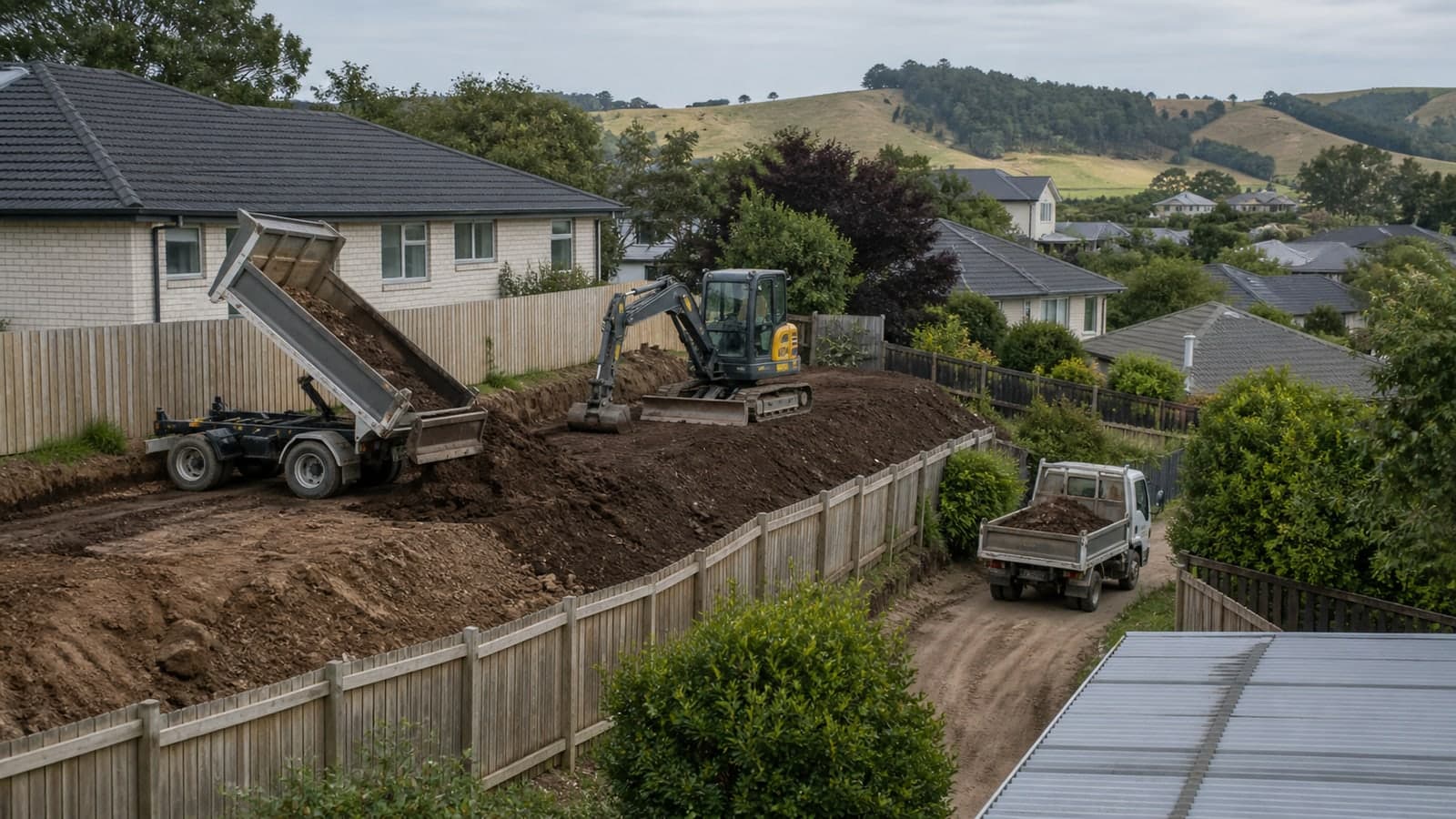
Cash does not, by itself, turn landscaping into an activity requiring resource consent. The risk arises when repeated deliveries increase the volume, area, depth, duration or environmental effects beyond what the relevant plans permit.
The council assesses the activity—not the label placed on each truckload.
A homeowner may call the work garden levelling and a contractor may call the material clean fill. Council will look at what was deposited, how much land changed, where it sits and what effects it creates. Check before accepting the first load rather than after the site has been raised.
Search a propertyWhen does cash for dumping fill become a consent problem?
Contractors face transport and disposal costs when excavated material must go to an authorised facility. A residential owner with spare land may therefore be offered cash to receive soil. One load becomes a second, then deliveries arrive whenever a landscaper or excavation crew has material to move.
Payment is not normally the statutory threshold. It matters because it can transform a defined landscaping project into an open-ended disposal arrangement. The owner may stop measuring cumulative volume, checking where material originated or considering final levels because every additional load produces income.
| Situation | Planning significance |
|---|---|
| One planned delivery | Its source, quantity, placement and finished level can be defined and checked in advance. |
| Weekly paid loads | Cumulative volume and duration grow. The activity may resemble an ongoing fill operation rather than incidental landscaping. |
| Material from changing sites | The owner may not know whether every load meets the applicable cleanfill definition. |
| Fill spread to create usable land | Finished levels, stability, retaining, drainage and effects across boundaries become central. |
Small payments can conceal a large cumulative earthworks project.
Ten truckloads arriving over several weeks do not necessarily become ten unrelated minor activities. A plan may treat them as one cumulative change to the site. Keeping each payment small does not divide the physical effects.
What determines whether resource consent is required?
New Zealand does not have one residential cleanfill allowance for every property. Territorial authorities control land use through district plans, while regional plans can regulate land disturbance, sediment, discharges, waterways and contaminated land. Both layers may need checking.
Total material and land affected may be measured cumulatively over a stated period.
A small footprint can still be significant where fill substantially raises the ground.
Placement near a boundary, bank or retaining structure can create engineering and neighbour effects.
Streams, wetlands, flood hazards, sediment and overland flow paths can trigger separate controls.
The source site and its past use matter even when material appears to be ordinary soil.
Coastal, heritage, ecological and natural-hazard rules can reduce ordinary allowances.
Bay of Plenty Regional Council explains that consent is needed when work does not meet permitted-activity thresholds. Auckland Council notes that earthworks consent considers geotechnical aspects and conditions for engineered excavation and fill. The precise rules must be checked for the site.
Calling it clean fill does not make the activity permitted.
Loads can contain demolition fragments, treated timber, ash, asbestos, hydrocarbons, invasive plants or soil from land with a contaminating history. Looking at a pile from the driveway is not a reliable assessment.
Even genuinely clean natural material can cause harm when placed over a flow path, against a fence, near a waterway or on an unstable slope. Resource consent questions concern both the material and the earthworks used to deposit, spread, compact and retain it.
- Know the sourceRecord where every load originated and who transported it.
- Know the contentsDo not rely only on a contractor calling material clean or grey fill.
- Measure the quantityTrack cumulative cubic metres before material is spread.
- Protect drainageDo not obstruct flow paths or redirect runoff towards neighbouring land.
What should an owner do before accepting fill?
- 01Define the finished project
Record the intended footprint, volume, depth, final contours and reason for the work.
- 02Check both councils where relevant
Ask the territorial authority about district-plan rules and the regional council about land disturbance and discharges.
- 03Confirm standards in writing
Give council the property and real quantities. A general comment about gardening is not a site assessment.
- 04Verify every source
Keep delivery records and evidence about material type. Decline unexpected or mixed loads.
- 05Stop at the assessed scope
Do not let a convenient disposal arrangement expand beyond the project that was checked.
What can a neighbour do when regular deliveries begin?
Record the exact property, dates and frequency, visible level changes and any sediment, dust or drainage effects. Photographs from your property or a public place can help when taken safely and lawfully. Do not trespass, obstruct vehicles or confront drivers.
Search Consenty for an available earthworks, land-use, subdivision or cleanfill consent. Then ask council whether a current resource consent authorises repeated deposit and levelling at the address. If no approval is identified, ask the planning compliance team to assess the activity.
Ask for a check, not a predetermined verdict.
“Please confirm whether filling or earthworks at [address] are authorised. Deliveries occurred on [dates]. If no authorisation is recorded, please refer the attached observations to planning compliance.”
Unauthorised fill can lead to stoppage, investigation and remediation.
Council may review records, request information, inspect where authorised and compare work with plan rules. A minor issue may be resolved voluntarily. Continuing or significant work can lead to a requirement to stop, an abatement notice, enforcement order, infringement or prosecution depending on the evidence and statutory powers.
The owner may need surveying, geotechnical or drainage evidence, contaminated-land assessment and a retrospective resource-consent application. Approval is not guaranteed. Material may need stabilising, removing or disposing of lawfully.
The enforcement framework is in the Resource Management Act 1991. Receiving cash can look attractive until professional reports, consent fees and remediation become payable.
Consenty can help locate an approval—but council remains authoritative.
Consenty aggregates available building and resource consent summaries from supported councils. Search the address and descriptions such as earthworks, filling, cleanfill, retaining, subdivision or land use.
Consenty currently tracks consents from 1 January 2026. An older resource consent may still authorise work: a consent can commonly have a lapse period of up to five years unless its decision specifies otherwise, and one already given effect may remain operative. Absence from Consenty is not proof no consent exists. Confirm directly with council.
For a broader neighbour-focused process, read When do earthworks need consent?
Cash, cleanfill and earthworks FAQs
Does accepting cash for fill automatically require resource consent?
No. Payment is not normally the legal trigger. Consent depends on the nature, scale, location and effects of the earthworks and whether every applicable district and regional plan standard is met. Regular payment can nevertheless indicate a continuing, cumulative operation rather than a small one-off landscaping job.
Is clean fill always permitted on residential land?
No. Material meeting a cleanfill definition can still breach earthworks, drainage, hazard, contaminated-land or amenity rules. Its source and contents must also be known rather than assumed.
Do several small truckloads count together?
They may. Plans commonly assess cumulative volume, area or effects over a period. Dividing a project into individual deliveries does not necessarily keep the overall activity within permitted standards.
How do I check whether a property has earthworks consent?
Search available records in Consenty, then confirm directly with the territorial and regional council. Consenty currently tracks records from 1 January 2026, while an older consent may still authorise work.
What should a neighbour report to council?
Provide neutral facts: the address, dates, delivery frequency, visible changes in level, sediment or drainage effects, and photographs taken safely and lawfully. Ask the planning compliance team to check whether the activity is authorised.
Can council require fill to be removed?
Depending on the facts and its statutory powers, council may seek voluntary compliance, require work to stop, issue an abatement notice, seek an enforcement order, or require stabilisation, removal or remediation. Retrospective consent may be possible, but approval is not automatic.
This guide is general information. Rules vary by council, plan, zone, overlay, material and site. Obtain direct council confirmation and professional advice where appropriate before accepting fill or alleging a breach.
Consenty is independent, not a council or enforcement agency. It presents available public consent information and does not determine whether work is lawful. This is not legal, planning, engineering, environmental, waste-management or property advice.