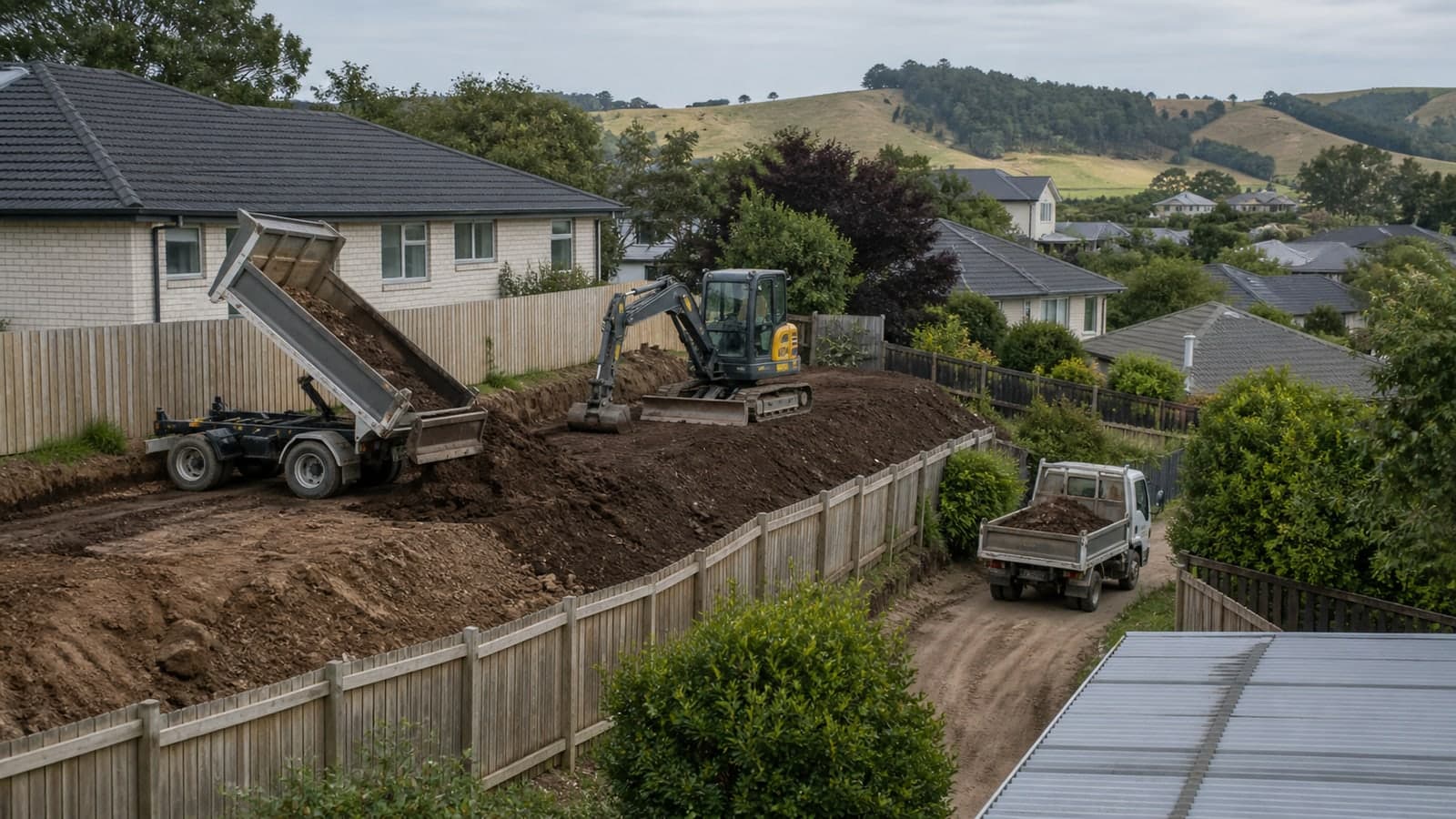
Earthworks may need resource consent when cut, fill, excavation or land disturbance exceeds the permitted standards for that property—or triggers separate rules for slopes, waterways, hazards, vegetation, contaminated land, sediment or drainage.
Check the property, not just the material being dumped.
There is no universal rule that allows a homeowner to receive unlimited “clean fill”. Search Consenty for an available consent record, then ask the relevant council whether the address has approval for the work. If council cannot identify one, ask its planning compliance team to check the activity.
Search a propertyWhen do residential earthworks need consent?
Every district and regional plan sets its own framework. Small gardening and landscaping works may be permitted, while larger excavation or filling can require resource consent. A volume that is permitted on one flat residential section may not be permitted on a steep site, beside a stream, within a hazard overlay or near a sensitive boundary.
Plans can control the cumulative quantity of soil moved and the total area disturbed over a stated period.
Changing the ground level by more than a permitted depth can trigger consent even on a modest section.
Waterways, coastlines, notable trees, slopes, heritage, hazards and contaminated-land overlays can introduce extra rules.
Sediment, dust, stability, retaining, drainage and overland flow paths can matter independently of raw volume.
“It is only landscaping” is not a planning assessment.
The relevant question is whether all applicable plan standards are met. Waikato Regional Council, for example, warns that earthworks directly affecting watercourses will normally require resource consent. Other councils impose different district-plan and regional-plan thresholds, so the exact address and work must be checked.
Cash for dumping can turn occasional landscaping into an ongoing fill operation.
Landscapers and small contractors sometimes need somewhere to dispose of excavated soil. A homeowner with spare land may accept truckloads in return for cash, then spread and level the material. A few deliveries can become a regular stream of trucks, particularly when each load produces another payment.
The labels “clean fill” and “grey fill” are often used loosely. Soil that looks clean may contain concrete fragments, treated timber, ash, asbestos, hydrocarbons, invasive plants or other material that is not acceptable cleanfill. Even genuinely clean natural material can create planning, engineering and drainage problems when placed in the wrong location or at the wrong scale.
| Claim | What still needs checking |
|---|---|
| “It is clean fill” | Where the material came from, what it contains, whether it meets the applicable definition, and whether depositing it is permitted. |
| “It is only landscaping” | Cumulative volume, disturbed area, finished levels, stability, retaining, sediment and drainage effects. |
| “The owner is allowed to alter their land” | District and regional plan standards, easements, overland flow paths, boundaries and any consent conditions. |
| “Each truckload is small” | The cumulative activity. Repeated deliveries can quickly produce a substantial earthworks project. |
Receiving money does not automatically make earthworks unlawful. It can, however, encourage the volume and duration to grow far beyond what a homeowner first intended—or what the district plan permits. Payment is also useful factual context for council when it indicates a recurring disposal activity rather than one small landscaping job.
What should you do if trucks are dumping fill next door?
- 01Record the property address
Be certain which legal property is receiving the fill. Do not assume the driveway or visible work identifies the correct parcel.
- 02Search available consent records
Use Consenty to look for earthworks, land-use, subdivision or related approvals associated with the address.
- 03Confirm directly with council
Consenty tracks consents approved from 1 January 2026, so an older approval may not appear in the platform. A resource consent can commonly have a lapse period of up to five years unless its decision specifies another period, and a consent already given effect may remain operative beyond that. Give the council the address and ask whether any current or earlier resource consent authorises filling, earthworks or a cleanfill activity. Direct council confirmation is the safest source of truth.
- 04Ask planning compliance to assess it
If no relevant approval can be identified, describe what is happening and ask for a compliance check rather than declaring that your neighbour is breaking the law.
- 05Provide lawful, safe evidence
Dates, frequency, visible ground-level changes and clear photographs can help. Photograph business names or vehicles only where safe and lawful. Stay on your property or in a public place; never trespass, obstruct a truck or confront workers.
Ask council a neutral, answerable question.
“Can you confirm whether resource consent or another approval authorises the repeated deposit and levelling of fill at [address]? If no approval is recorded, please refer this information and the attached observations to the planning compliance team for assessment.”
A compliance investigation is a check—not proof of an offence.
Council may review its records, speak with the owner or contractors, request information and inspect the property where it has lawful authority. The officer will compare the actual work against the relevant plan rules and any existing resource consent.
- No breach identifiedThe work may be permitted or already authorised, and council may close the report.
- Informal resolutionFor a minor or readily corrected issue, council may explain the rule and seek voluntary compliance.
- Work required to stopWhere appropriate, council can require a person to cease or not start an activity, including through an abatement notice.
- Formal enforcementMore serious or unresolved matters can lead to an enforcement order, infringement or prosecution depending on the evidence and statutory powers.
An abatement notice is not simply a customer-service warning. Auckland Council describes it as an official notice requiring a person to follow a specific course of action. The powers and procedures sit under the Resource Management Act 1991.
See Auckland Council’s explanation of consent monitoring and enforcement responses.
Retrospective approval may cost far more than checking first.
If the work is not permitted, the owner may need to stop receiving fill and stabilise the site. Council may require information about the source and quantity of material, finished levels, drainage, sediment control, retaining structures and effects on neighbouring land.
A retrospective or “historical earthworks” resource-consent application may require a planner, surveyor, engineer or contaminated-land specialist. Approval is not guaranteed, and council may instead require material to be removed or the land remediated. A later consent does not necessarily remove liability for the earlier breach.
Establishing original and current levels can be difficult once material has been spread.
Raised ground may require stability, retaining and stormwater assessment.
Unknown fill can require sampling, disposal records or contaminated-land advice.
Continuing or expanded work must fall within any granted consent; materially different earthworks may require another approval.
If progress is not made, council may consider an abatement notice or other enforcement response. For an owner who has accepted hundreds of dollars a week for fill, planning, technical and remediation costs can quickly exceed the cash received. That financial and enforcement risk is a strong reason to verify the rules before the first truck arrives.
Turning a blind eye can become expensive for the neighbour.
Many neighbours understandably avoid conflict. But raising land can redirect stormwater, obstruct an overland flow path, alter retaining loads, increase sediment or change how a lower property drains. The effects may not become obvious until prolonged rain or a future subdivision places more pressure on the site.
Early information creates options before the land is permanently changed.
Once large volumes have been spread and compacted, proving where the material came from and restoring the earlier ground profile becomes harder. Checking consent records and raising a factual concern early can protect both properties without requiring a direct confrontation between neighbours.
Locate the available consent record, then verify with council.
Consenty aggregates available building and resource consent summaries from supported councils. Search the property address and relevant descriptions such as earthworks, filling, cleanfill, retaining, subdivision or land use. A result can give you the council, reference, dates, status and description needed to frame a better enquiry.
Absence from Consenty is not proof that no consent exists. Council remains the authoritative source, and publication coverage varies. For suspected unauthorised work, the best route is to confirm approvals directly with council and ask its planning compliance team to investigate where appropriate.
Residential earthworks and fill FAQs
When do earthworks need resource consent in New Zealand?
There is no single nationwide volume that answers this for every property. District and regional plan rules vary by council, zone, slope, site area, proximity to water, natural hazards, contaminated land, vegetation, season and the amount and depth of cut or fill. Check the rules for the exact property and proposed work with the relevant council.
Can a homeowner accept clean fill without resource consent?
Sometimes small-scale filling can be permitted, but calling material clean fill does not make unlimited dumping permitted. The material must meet the relevant definition, and the activity must comply with applicable district and regional plan standards. Repeated deliveries, significant level changes, drainage effects or work near boundaries and waterways should be checked with council.
Does being paid to accept fill make the earthworks illegal?
Payment does not by itself determine whether resource consent is required. The relevant issues are the nature, scale, location and effects of the activity and whether plan rules are met. However, regular paid deliveries may indicate an ongoing operation whose cumulative volume quickly exceeds permitted standards.
How can I check whether my neighbour has earthworks consent?
Search available records in Consenty, then confirm directly with the territorial or regional council. Give council the property address and ask whether any current resource consent authorises filling, earthworks or cleanfill activity. If no approval can be identified and the activity is continuing, ask the planning compliance team to assess it.
What evidence should I give council?
Provide factual observations: the address, dates and approximate times, frequency of deliveries, visible changes in ground level, drainage or sediment effects, and photographs taken lawfully and safely from your property or a public place. Vehicle or business details can help when clearly visible, but do not trespass, obstruct vehicles or confront workers.
What can council do about unauthorised earthworks?
Council may make enquiries, inspect where legally authorised, seek records, issue warnings, require work to stop, serve an abatement notice, seek an enforcement order or take prosecution action depending on the facts and seriousness. The response is discretionary and an investigation does not prove a breach.
Can historical earthworks receive retrospective resource consent?
A property owner may be asked to apply for consent for completed or continuing work, but approval is not automatic. Technical reports, surveying, engineering, contaminated-land assessment, drainage design, stabilisation or remediation may be required. A later consent also does not necessarily erase liability for earlier unlawful work.
This guide is general information. Earthworks rules vary by council, plan, zone, overlay and site. Use the relevant district and regional plan and obtain direct council confirmation before relying on a permitted-activity threshold or alleging a breach.
Consenty is an independent service, not a council or enforcement agency. It presents available public consent information and does not determine whether work is lawful. This article is not legal, planning, engineering, environmental or property advice. Do not trespass, obstruct vehicles or put yourself at risk when observing work. Report immediate safety or pollution risks to the appropriate authority.